Hill and house, living together

Thomas_House

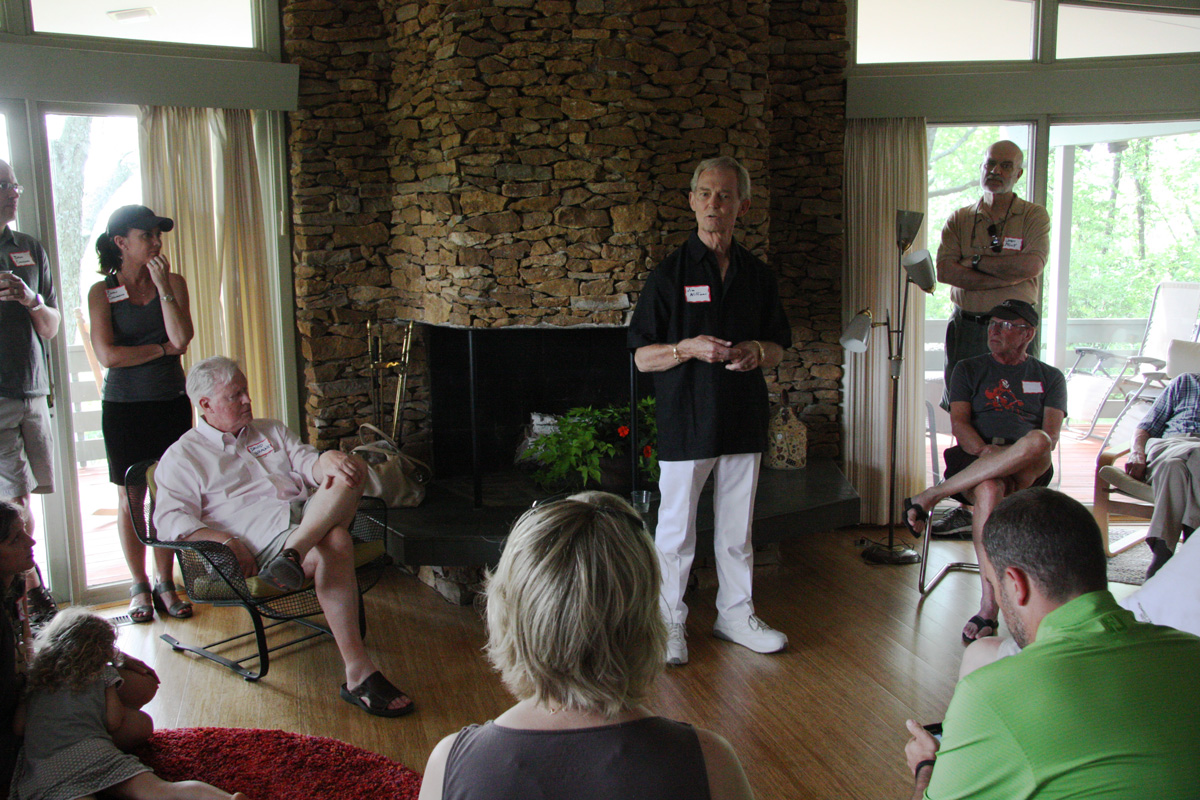
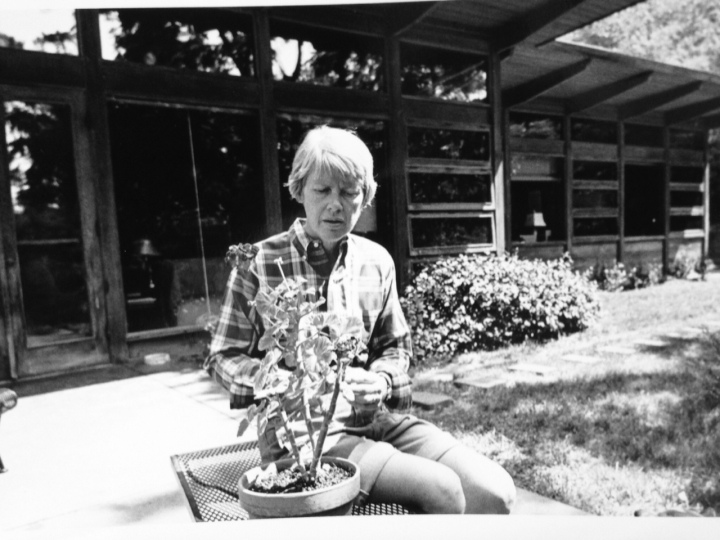
“No house should ever be on a hill or on anything,” Frank Lloyd Wright famously advised. “It should be of the hill.” Few houses in Lawrence adhere to this Usonian principle better than Deb & Ray Rowden’s home at 1904 Meadowlark Lane in Lawrence, one of our top “Baker’s Dozen” houses. Designed in 1968 by Lawrence architect James Williams, AIA, and landscaped by KU’s first landscape architect, Alton Thomas, the house fulfills the rest of Wright’s decree: “Hill and house should live together each the happier for the other.” Come see what this marriage of hill and house has wrought on Sunday, June 29th from 3:00 – 5:00. You won’t be disappointed!

Getting there: From Iowa Street, turn west on Clinton Parkway, right on Lawrence Ave., drive up Marvonne Road and turn right on Meadowlark Lane. Parking will be challenging so please carpool and or park on Marvonne. It is a pleasant short walk up the hill. You will see the Lawrence Modern signs.

We look forward to sharing this special home, the people who designed it, and those who are now the stewards.

Please bring a small treat to share with modern friends.

Snaps from Ron Labinski’s talk at Nunemaker Center

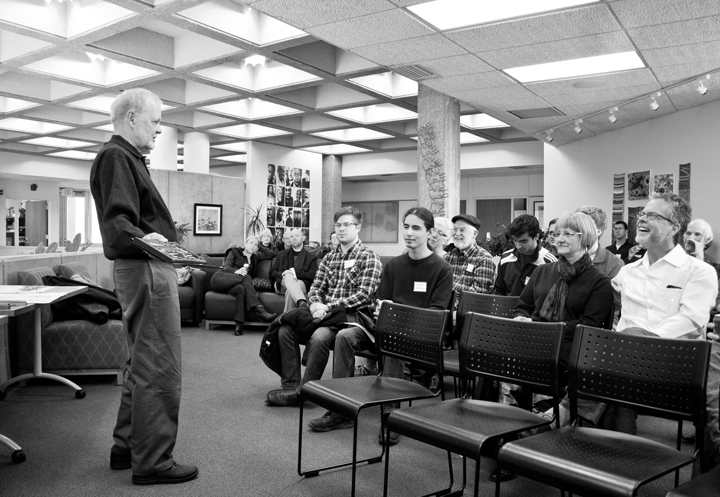
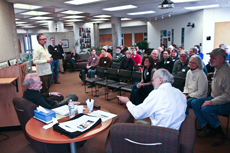
Architect Ron Labinsky talks to the Lawrence Modern group at the Nunemaker Center Feb. 23, 2014

Architect Ron Labinski, FAIA, speaks to the Lawrence Modern group about his design of the Nunemaker Center, February 23, 2014.

Lawrence Modern was honored to have renowned (and retired) architect Ron Labinski, the “father of sports architecture,” speak about his life in architecture at the Nunemaker Center on Sunday, Feb. 23. Ron was the first architect to specialize in sports and build an entire division of a large firm around it, HOK Sport. Ron introduced many innovations in sports architecture, but before all that happened he was a young modernist working at the Kansas City firm Kivett & Myers when he got an opportunity to design the Nunemaker Center on the KU campus in 1969. The result was a postmodern exercise in concrete forms that still feels fresh, artistic and contemporary. Well worth checking out if you’re on west campus near the Jayhawk Towers. Thank you Mr. Labinski!

Discover Nunemaker Center Feb. 23

nunemaker-copy


The Nunemaker Center, home to KU’s Honors Program, keeps a low profile. A completely unobtrusive and unremarkable building along Engel Road, it often goes unrecognized by people who’ve lived in Lawrence for years. One reason why is because it is dwarfed by large multi-story buildings nearby, rendering it nearly invisible by comparison. But it is a ballerina among brutes. The unassuming facade hides a revelation inside — a stimulating mix of concrete geometrical shapes, angles and light. As envisioned by Irene Nunemaker, a longtime executive with Avon cosmetics whose generosity made the building possible, the design was to provide an “exciting educational environment” for students. It has indeed done well in that regard. All of which is a bit ironic: it was designed by Ron Labinski, FAIA, an architect regarded as the father of sports facility architecture. But the architecture speaks for itself. It has be seen to be appreciated, or perhaps discovered for the first time.

Lawrence Modern to speak at AIA conference

AIA

Lawrence Modern has been invited to present at the 2013 Kansas American Institute of Architects conference at the Holiday Inn in Lawrence, Sept. 12. During our breakout session (3:45 – 5:15) we will explain the purpose of our group, our preservation efforts, and discuss the results of our survey to identify significant mid-century properties in town. For more information about the conference, here is the brochure. Registration is required — here’s the website. We are honored to showcase our mid-century homes and other buildings to AIA architects.

                                                                                                                                                     —Tom, Bill + Dennis

Livin’ the dream in C.S.H. #22

SH_entry_lowres

Western facade at entry. Photo by Akiko Takeyama

Built on a surge of adrenaline in modern architecture, the Case Study program houses constructed in the Los Angeles area from the 1940s to the 1960s were a unique experiment in postwar America.

Conceived by John Entenza, the editor of Arts & Architecture magazine, these flat-roofed, post-and-beam structures explored the advantages of modern residential living but also promoted the economical concepts of mass production. Assembled on slabs of concrete and often using prefab components to reduce costs, they challenged preconceived notions of residential building design and engineering. Despite their relatively low cost and seductive appeal, however, only 25 were actually built — they never really resonated with the general public.

In retrospect, the Case Study program represents not only a high point in modern architecture but also a utopic vision of America, where people of modest means could afford to live in houses that were essentially artistic creations.

The Stahl House epitomized this vision. Designed by architect Pierre Koenig in 1959, C.H.S. No. 22 is a masterpiece of modernism, one that has become so iconic it’s easy to overlook the fact that it was built for a family of four with limited resources. (CH “Buck” Stahl, the original owner, was a graphic designer and sign painter who at times struggled to keep up with the bank payments.) The idea that a middle class family could even imagine living in such a work of art, and continue to own and preserve it today, is a great defense of the American Dream, such that it exists.

Gazing out the living room of the Stahl House.

Gazing out the living room at the Hollywood Hills and the Pacific. Photo by Akiko Takeyama

My wife and I recently had the opportunity to tour the Stahl House on a trip to Los Angeles. More than any other house I’ve visited, it left me in a state of wonder that lingered long after I set foot on the property. Of course much of this has to do with the magnificent views, which sweep from the ocean to the mountains, but also the elegant way in which Keonig’s design melds with the grid-like pattern of the cityscape below. It fits the picture. The huge glass windows bring this copper-toned spectacle into full view by day; by night the lights of L.A. itself become a sparkling Tiffany window.

Living room view at sunset.

Looking west from living room at sunset.

There is something truly transcendent about being in this space, floating above the city: it’s powerful, sexy. Though I wonder if that joy might fade after a while, and the spectacular views become taken for granted. It happens. And the house itself is not without issues. By today’s standards the kitchen and bathrooms are tiny, the living room lacks privacy, and the house is after all perched on the edge of a steep cliff in an earthquake-prone city. No house is perfect, right? Nah, I must be having a nightmare. Because the thought of living in this cinematic masterpiece, where every moment is a slo-mo rush on the senses, even nightmares would be the stuff of dreams.

If you plan to visit L.A., the Stahl House is available for touring through their website. Highly recommended!

        —Bill