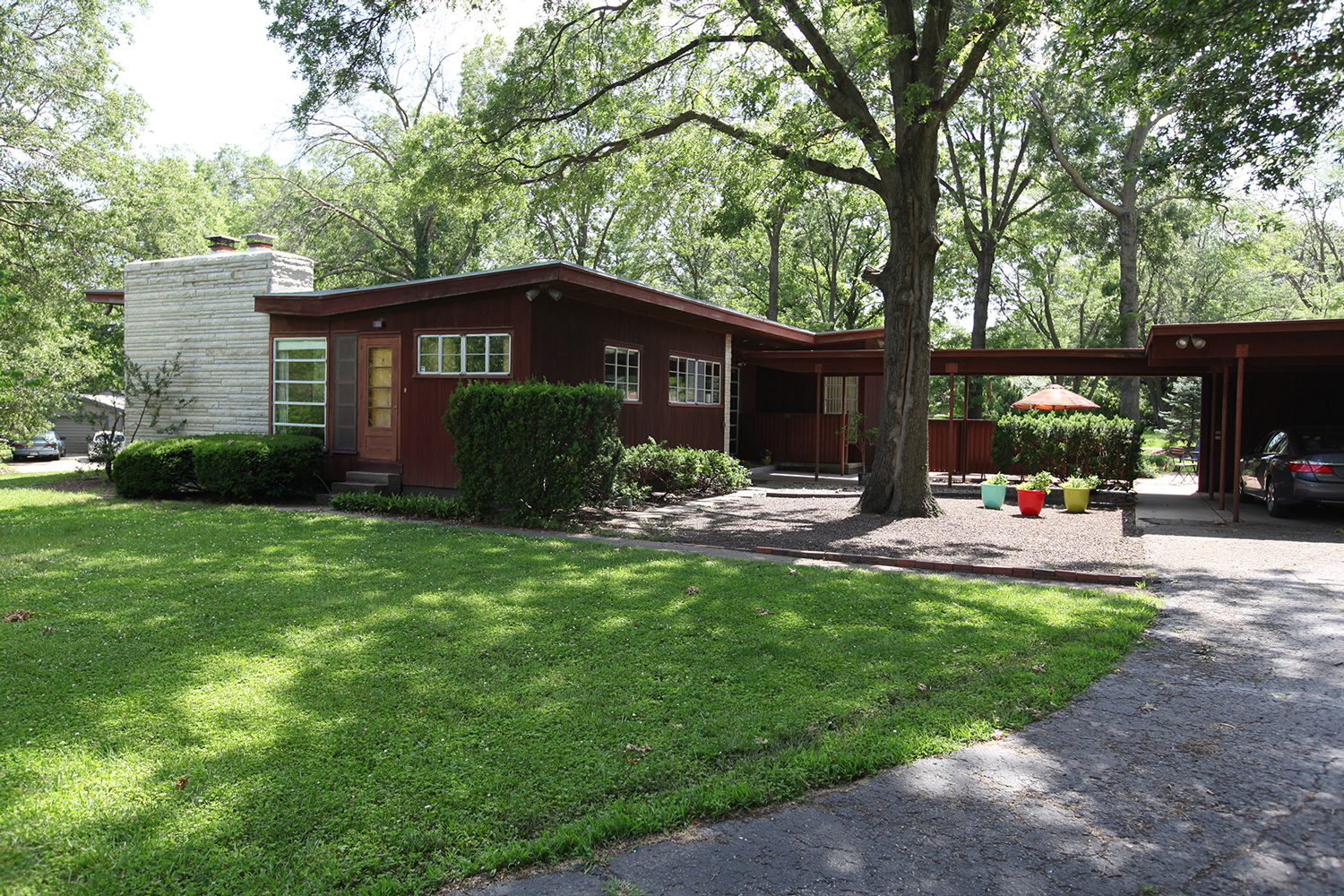
Modern fans bask on butterfly roof

Blank_House_June_2015_1_sm

“I loved the light and the trees,” said Elaine Blank in response to the question of what she enjoyed the most of her 60 plus years in the house at 2133 Owens Lane. In 1951 Elaine and her husband, local photographer Robert Blank, purchased plans from House Beautiful magazine. Their desire to live in something new and adventurous led them to build this unique butterfly roofed structure. They moved into the completed home in 1953. Last Sunday (June 7) the new owners of the Blank House, KU philosophy professor Dale Dorsey and family, hosted a Lawrence Modern open house reception. After an introduction to the history of the house by Tom Harper, the 75 attendees were treated to an eloquent soliloquy by our resident architecture historian and modernist guru Dennis Domer. Dennis described the 1950’s context that pushed young couples like the Blanks to seek out modernist design. The country was optimistic about the future and the future was all about the new. Dennis reminisced about his own father’s attempt to modernize their home by installing the same type of mahogany paneling as in the Blank House. The paneling in the Blank House is indeed gorgeous, but the question on the minds of most in attendance concerned the roof and its drainage (especially due to our abundance of recent rains). Dale explained that the roof drained into a large center drain that carried the water off the property. A system that many seemed to question, but Dale said it has continued to work successfully. As visitors walked through the house admiring the architecture, observing the light and the views to the exterior trees, Mrs. Blank, our guest of honor, stood in the kitchen and remarked how beautiful the house looked. Although she came mostly to see the wood floors that had been covered with carpet since the mid 1950s, she left with high praise for how the new owners have preserved the house that had been such a part of her life.

Lawrence Modern would like to thank Dale Dorsey and his family for opening up their home and letting our members experience this wonderful example of mid-century modernist architecture.

—Tim

Blank_House_June_2015_2_sm

Open_House_Blank_House_June_2015_3_sm

Open_House_Blank_House_June_2015_2_sm

Open_House_Blank_House_June_2015_11_sm

Open_House_Blank_House_June_2015_4_sm

Open_House_Blank_House_June_2015_10_sm

DIY modernism June 7th

Lawrence Modern event poster

Design: Aimee Wray

Back in the days before Eisenhower was president, Bob and Elaine Blank were a typical young couple driving around Lawrence looking for a place to build their dream house when they found a barren-looking lot south of the KU campus for $2,000. At the time, Blank was a professional photographer who admired the architectural photography featured in House Beautiful magazine, which highlighted the seductive appeal of southern California modernism. After seeing plans for a modern house with a butterfly roof advertised in the magazine, they decided to go for it and build such a house themselves to save money. Blank purchased the plans in 1951 for $100, plus postage, and got to work.

After adding a basement and more windows to the original design, they completed the house with the help of Blank’s father-in-law and local contractors. Later on they added a covered breezeway and a double carport, punctuating the laid-back California contemporary feel of the property. The Blanks made all the right moves with their DIY project, including hiring a young modernist architect named Dick Peters to design their renovations, resulting in one of the most distinctive modern houses in Lawrence. The house is on our Baker’s Dozen list of top midcentury houses in the city. The Blanks lived in the house until Bob passed away a couple of years ago at age 83. We are fortunate that the new owners respect the integrity of the house and wish to share it with us. We look forward to seeing you June 7th.

PS: Please do not park on Owens Lane. It is a cul-de-sac and difficult to navigate with parked cars. Please park on 21st and Alabama.

—Tom, Bill, Dennis & Tim

Modernism in Film: a New Series

Lawrence Modern Film Series poster featuring promotions for director Jacques Tati's "Playtime" and "Mon Oncle"
Design by Tim Hossler

When Tim Hossler, an assistant professor in KU’s Department of Design, approached Lawrence Modern last fall with the idea of collaborating with the School of Architecture on a series exploring modern architecture in film, we reached a consensus almost instantly. The concept is appealing: examine the role that modern architecture has played in film—the modernist medium par excellence—appreciated through the eyes of KU School of Architecture faculty. The venue is ideal: the new Forum at Marvin Hall, a light-controlled glass box designed by students in Prof. Dan Rockhill’s Studio 804 class. How could we refuse? Indeed, we are very fortunate to have this connection with the university and delighted to have award-winning author and Professor of Architecture Stephen Grabow introduce the first two films of our modernism in cinema series.

On April 1st, appropriately enough, we will screen Playtime, French director Jacques Tati’s 1967 film that, along with his earlier film Mon Oncle, is the basis of our “Can Architecture be Funny?” tagline. Tati stages architectural jokes in which people’s interaction with modern architecture, or modernity, is oftentimes quite amusing. “Playtime is a great start to this series because it illustrates the dysfunctionality of certain aspects of modern architecture,” Grabow says. “The contrast between organic and mechanical—with people being organic and modernism being mechanical—is brilliant and highly entertaining.”

Please join us at The Forum on April 1st. Prof. Grabow will introduce Playtime at 7 p.m. A discussion will follow the screening of the film. Please refer to the flyer for details about the next film in the series, Mon Oncle, which we will screen in May. (The flyer can be enlarged for high-resolution viewing by double-clicking.)

We wish to thank Prof. Hossler and the KU School of Architecture for collaborating with us on this exciting film series and generously providing use of The Forum. If you haven’t seen this striking new addition to Marvin Hall, it’s reason alone to attend this film!

All films are free and open to the public.

—Tom, Bill, Dennis & Tim

Shibui: ‘Easy to live with beauty’

Author Patricia Graham discusses her book, Japanese Design: Art, Aesthetics, and Culture at the Lawrence Public Library Jan. 11.

Author Patricia Graham discussed her book Japanese Design: Art, Aesthetics, and Culture at the Lawrence Public Library on Jan. 11.

It would be hard to overemphasize the influence that Japanese design has had on the development of modern architecture in the West. Indeed, nearly 400 years after the Katsura Imperial Villa was constructed in Kyoto, modern architects are still in awe of the precise geometrical forms of its sukiya-style buildings and the abstract beauty of its gardens. Indeed, as local author Patricia Graham reminded a group of more than 100 who gathered on January 11th at the Lawrence Public Library, much of what we now view as modernist architecture has its origins hundreds of years ago in Japan. This truth has not been overlooked—the great German architect Bruno Taut wrote three incisive books about the contributions of Japanese architecture to modernism a century ago—but it bears repeating and humble respect.

Graham’s talk, which was coupled with the recent publication of her book, Japanese Design: Art, Aesthetics & Culture, celebrated not only Japan’s architecture and fine art but also how Japanese refinement extends to even the most mundane objects, such as utensils and snack food packaging. She explained the origins of this refined aesthetic sense—clarifying the meaning of words like wabi, sabi, and shibui, which are often carelessly used to describe it—in the context of Japan’s religious and cultural history. As an art historian and appraiser of Asian art, Graham also gave a bow to curators of Japanese art, such as Langdon Warner, an art historian who traveled extensively throughout Japan in the early 1900s, purchasing rare objects that are now preserved in museums. Another, of course, was Frank Lloyd Wright, who collected more Japanese woodblock prints than anyone in history and was obsessed with Japanese art, design, and architecture. What goes around comes around.

Dr. Graham’s presentation was interesting and engaging. Lawrence Modern appreciates her work and wishes her success with her new book. Arigatou Gozaimasu!

Lawrence Public Library, Jan. 11th:

midcentury design talk flyer - Patricia Graham

Emerging from the devastation of World War II, Japan entered an intense period of reconstruction in the 1950s, propelled in large part by international successes in design-related industries. These attracted the interest of foreigners in residence and soon came to the attention of Elizabeth Gordon, editor-in-chief of House Beautiful magazine from 1941 to 1964, who set out to explain the beauty of Japanese design and its relevance to the modern American lifestyle in two issues of the magazine (August and September 1960). Both were highly influential among American architects and designers. A staunch advocate of a more comfortable alternative to the rigid anonymity of orthodox modernist architecture, Gordon admired the humanistic and livable qualities of Japan’s design aesthetic. This talk will explore what this aesthetic is all about, as discussed in Patricia Graham’s new book, Japanese Design: Art, Aesthetics, and Culture (Tuttle), and how it helped shape the appearance of mid-century modern design in America. Come join us for a stimulating conversation about this fascinating topic. The event is sponsored by Lawrence Modern and KU’s Center for East Asian Studies.