Studio 804 hatches new ‘EcoHawks’ building on west campus

The new "EcoHawks" Hill Engineering Center building on KU's West Campus.
The new “EcoHawks” Hill Engineering Center building on KU’s West Campus. Photo: Bill Steele

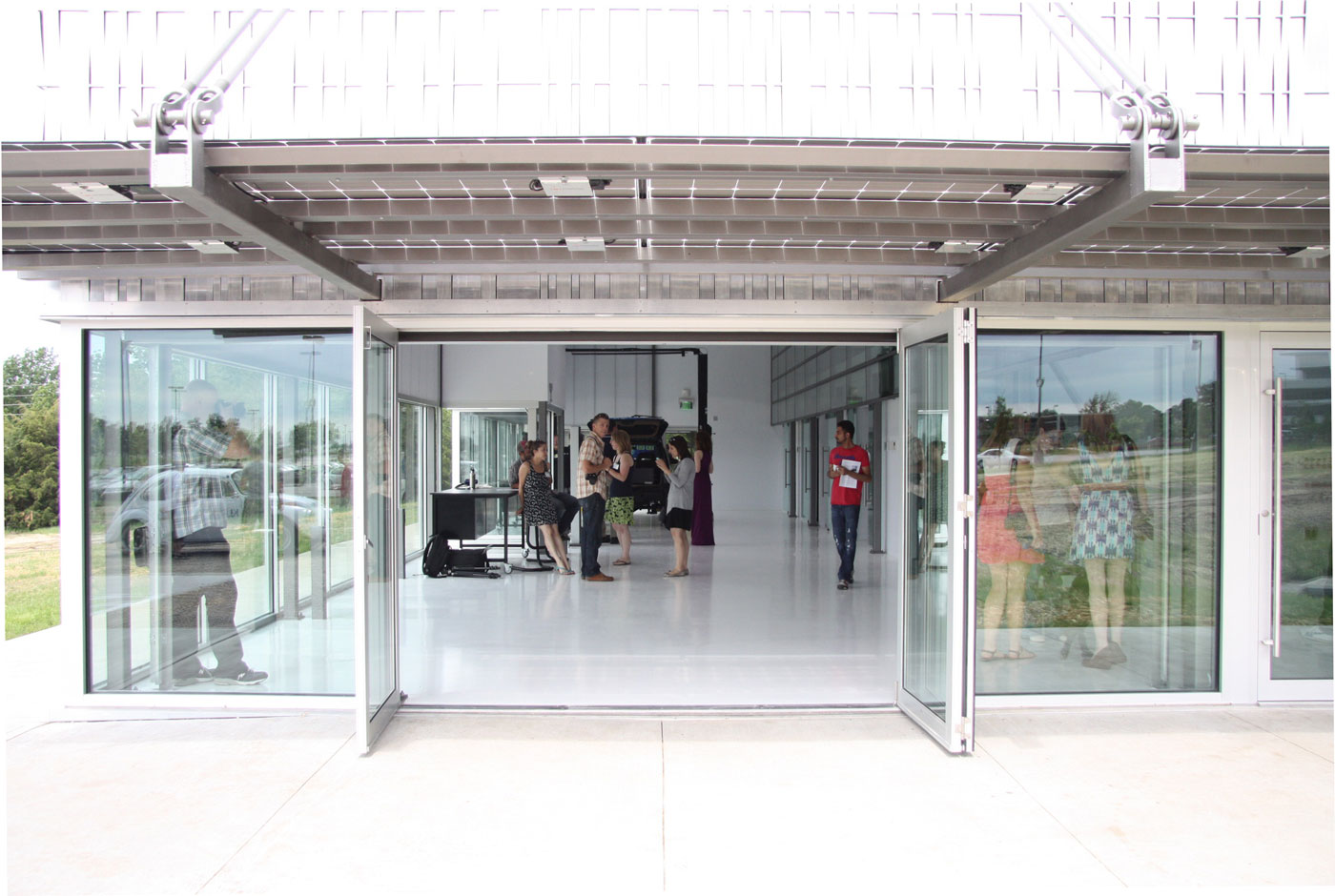
Studio 804’s latest addition to our built environment, the ‘EcoHawks’ research facility, was opened to the public this past weekend. Like its older brother across campus, the Center for Design Research, the EcoHawks building is a test bed of energy sustainability, designed to be net zero, which means it will produce more energy than it actually consumes. That extra energy will be used by engineering students to design electric vehicles that can run the building at night. Smart idea. These students are constantly thinking outside the box, and their buildings are teeming with innovative ideas and technologies. Some of these ideas could change the world, fulfilling KU’s oft-stated mission. But in that clean-lined, high tech future they envision we’ll all someday be living in, it would be nice to interact with materials other than just steel, glass and concrete. We would love to see future buildings that are warmer and more inviting, especially on the inside. This could be achieved quite easily and would not necessarily cost more. Class of 2014, we hope you are listening.

HERC2
Front entrance.
HERC3
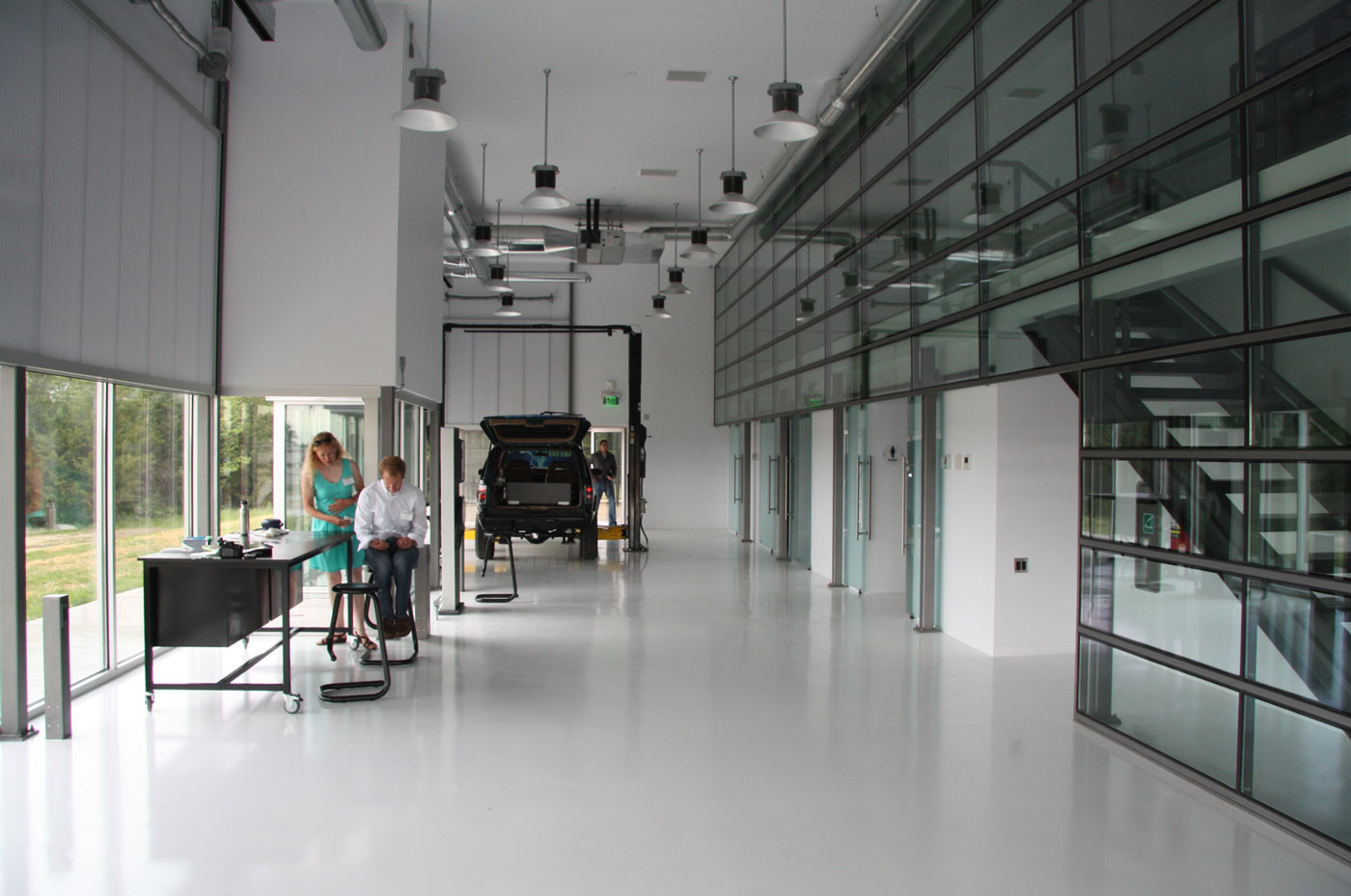
Engineering lab/Vehicle test bay. Here, engineering students who participate in KU’s Kansas Sustainable Automotive Energy Infrastructure Initiative (a.k.a. Ecohawks) will recycle old cars and make them run on primarily renewable resources.
HERC4
Visitors mingle in the building’s utility space. Photo: Bill Steele
Tom Harper with Max Anderson, a former student in the Studio 804 class.
Tom Harper with Max Anderson, a former student in the Studio 804 class. Max helped design and fabricate the building’s innovative motorized aerogel insulating panels, which trap heat collected by the concrete floor in winter. Photo: Bill Steele
HERC5
From left, Elizabeth Avenius, Kelli Hawkins and Hannah Hindman, former Studio 804 students who helped design and build the “EcoHawks” Hill Engineering Research and Development Center. (All graduated in May with a Master’s in Architecture.) Elizabeth hatched the idea to use recycled aircraft aluminum to create the building’s striking weaved exterior. Photo: Bill Steele

Please join us …

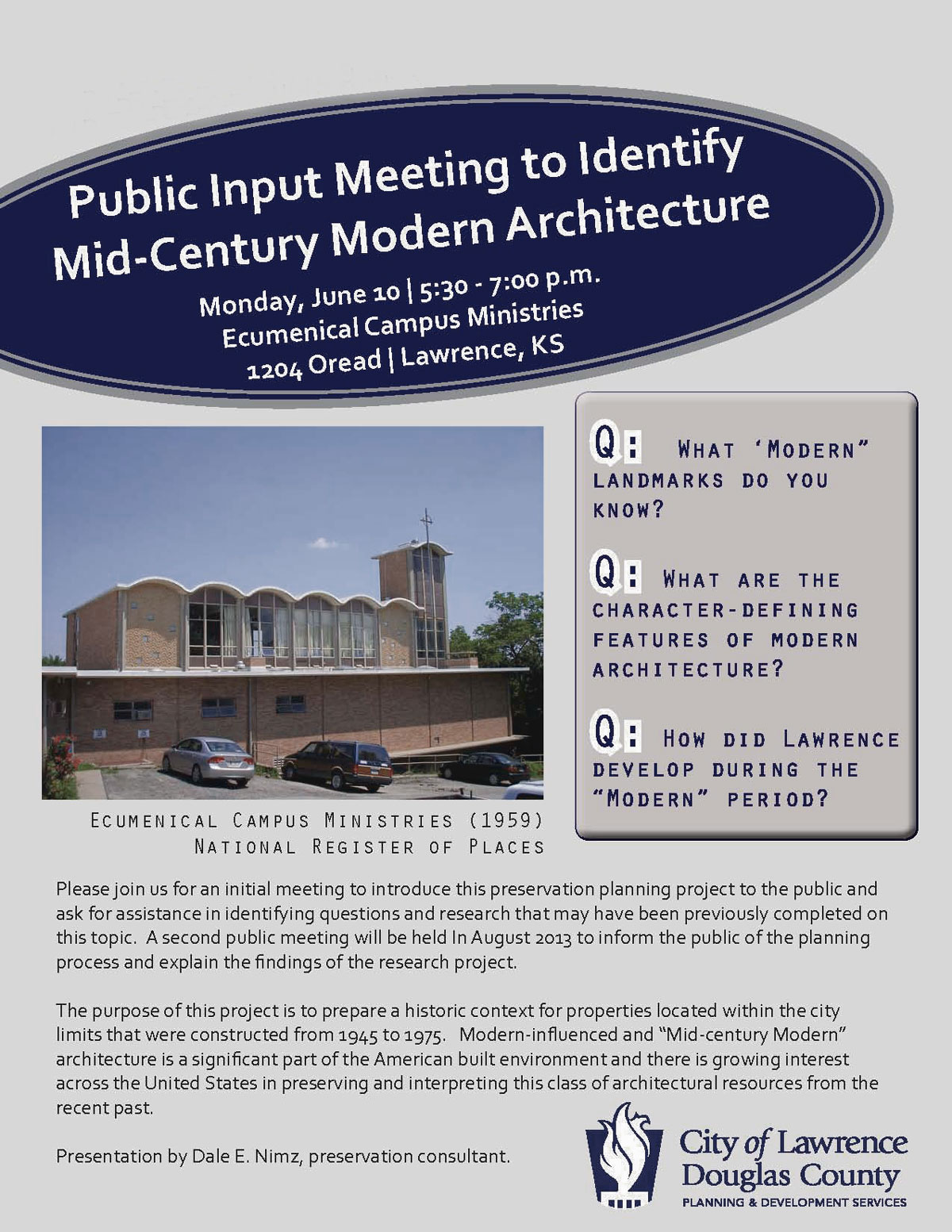
Public Meeting to Identify Mid-Century Modern Architecture in Lawrence, KS poster

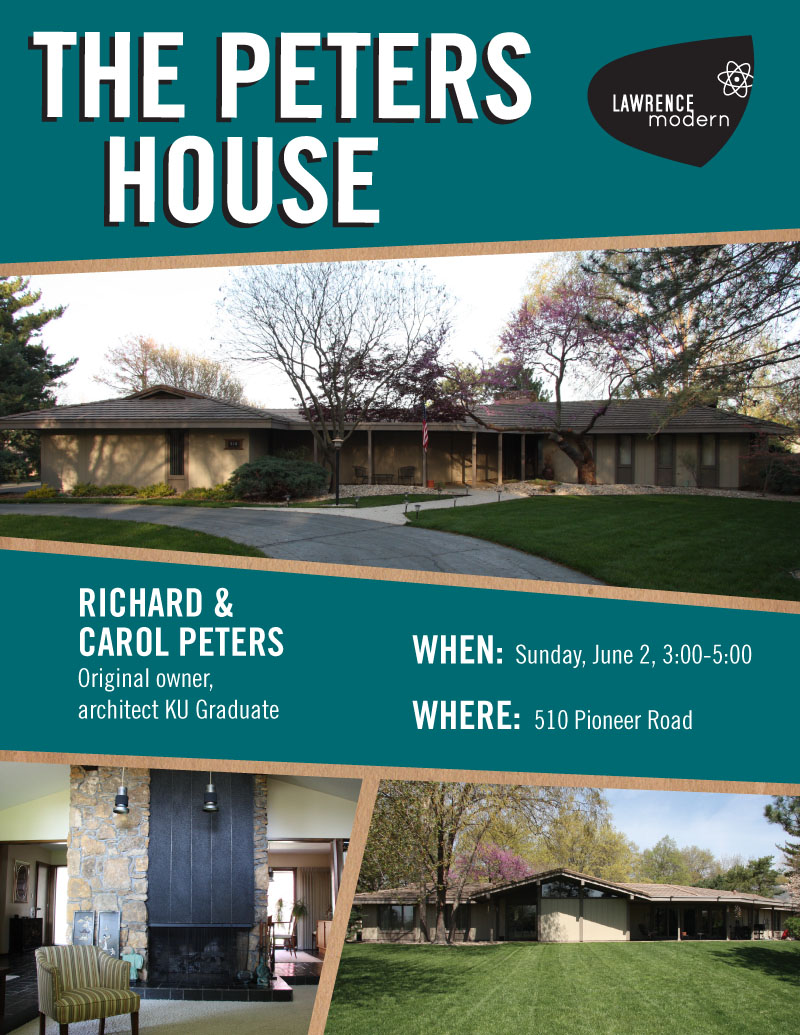
Pure-blood architecture June 2nd

Peters House event flyer

Design by Aimee Wray

Regulars on the Lawrence Modern house tour scene, architect Dick Peters and his wife, Carol, have for years endured our pleas that they open their own mid-century home for viewing. We are pleased to announce that they have finally relented. Designed by Dick himself in 1968, the Peters Residence is the quintessential suburban rancher, or what Dennis calls “pure blood American… an exceptional Mid Century Modern house, designed by one of Lawrence’s important architects.” In other words, another Lawrence Modern event you don’t want to miss.

100 years of architecture at KU

Architecture_timeline/collage

Timeline in Marvin Hall celebrating 100 years of architectural education at the University of Kansas. Timeline by Tim Hossler.

KU’s School of Architecture celebrated a century of architectural education April 26-27, 2013, filling the corridors of Marvin Hall with former students who reconnected with classmates and reminisced with faculty about their experiences attending one of the oldest and most prestigious architecture schools in the country. More than 350 alumni, faculty and friends attended the centennial events, including retired modernist architects Robert Hess, ’49, and Dick Peters, ’54, both of whose work is featured in this website. A wall-sized graphical timeline of the last century’s major events as they relate to the evolution of architecture, and the milestones of the School, was on display in the main hallway and became the central meeting point. (The Timeline was designed by Lawrence Modern’s own Tim Hossler.) Architectural models, drawings and exhibits of former and current students lined the School’s walls and corridors. A birthday cake was served on the lawn outside Marvin Hall, followed by a lively reception and evening banquet. Several architecture students interacted with their predecessors, but most were too busy working on their final projects to hang around or even go outside to grab a piece of cake. Such is the demands of pursuing the architecture profession. But fifty years from now, when the University celebrates the next milestone of this influential and far-reaching education program, they’ll surely have their cake and eat it too.

Hess_Sprecklemeyer_DomerProf. Kent Spreckelmeyer, Bob Hess, BArch ’49, and Prof. Dennis Domer.

Hess Bob Hess meets with architecture students Kyle Kutz (left) and Cole Giesler (middle) in Marvin Hall.

Gaunt_FultonJohn Gaunt, dean of the School of Architecture, Design and Planning talks with Duncan Fulton, ’78, FAIA, President/CEO of the Good, Fulton & Farrell architecture firm based in Dallas, Tex.

alumni From left, Neal Angrisano, ’88 and ’96, AIA, Associate, Burns and McDonnell Architecture, Kansas City, Mo. and Adjunct Professor; Sonya Jury, AIA, ’88, Director of Business Development, Henderson Engineers, Lenexa, Kans.; Steve Smith, AIA, ’88, Principal, Kenneth Hahn Architects, Omaha, Neb.; and John Eyler, AIA, ’94, Principal, 360 Architecture, Kansas City, Mo.

_Alumni_red_dotsAn Architecture alumnus sticks a red dot next to his name and year of graduation.


Where KU faculty retire

East facade Sprague apartments

East facade Sprague apartments

Lawrence possesses a large number of modern university apartments and dormitories built large and small across the campus of the University of Kansas during the 1950s and early 1960s. One of the smallest but, in some ways, most ambitious of this housing type is Sprague Apartments, designed by Kansas architect Charles L. Marshall (1905-1992) and built in 1960. Professor Elizabeth Sprague (1874-1960), Professor and Department Head of Home Economics at the University of Kansas from 1914 to 1941, gave the apartment block to the University in memory of her sister, Amelia.

Charles Marshall was born in Atchison, Kansas, and received his professional architecture degree from Kansas State University in 1931. He was the State Architect from 1945 to 1952, and he had a private practice in Topeka from 1952 to 1986 when he retired. Mr. Marshall was an architect who loved to draw and claimed to draw something every day. His efforts resulted in a large collection of watercolors, paintings, drawings, architectural drawings, linoleum cuts, and letters at the University of Kansas and Kansas State University. Besides the Sprague Apartments, Marshall also designed Smith Hall, which houses the University of Kansas Department of Religious Studies.

Sprague apartments north facade

Sprague Apartments’ north facade

Sprague Apartments is a bold rectangle of concrete and brick with limestone trim that juts out unabashedly from one of the steepest faces of Mt. Oread at 1400 Lilac Lane. The north facade provides consistent rows of red and brown brick ribbons articulated by long horizontal strips of concrete lines that express the floors and line up the fenestration. In contrast to this strict “front side” of the house facing north on 14th Street, the sunny south façade functions as the “back of the house” and is softened into a relaxed U-shape with three inset rows of continuous balconies that serve the nine apartments for retired faculty.

The front entrance to Sprague Apartments is on the west facade, which attaches a balanced complex of vertical and horizontal masses and lines to an arched walkway that bridges to Mt. Oread behind Danforth Chapel. The west end of this building functions not only as an entry and foyer but also provides vertical circulation for a stair and elevator, made clear by a white hexagonal concrete block motif.

Sprague Third Floor Entrance

Sprague Third Floor Entrance

The laid-back look of the south elevation belies nine tightly designed floor plans, six of which are two-bedroom apartments and three on the west end that are one-bedroom apartments. These apartments give retired faculty less than 1,000 square feet of living space at a very inexpensive price.

South facade

South facade

The entrances to these apartments are off the balconies, and a door opens into a living and dining room that spans the width of the building.

Living room

Living room

Dining area

Dining area

On one side of the living room is a hall leading to a bathroom and two bedrooms. On the other side, the living room fuses with a small dining area connected to a narrow kitchen.

Sprague Apartments hall and dining nook

Sprague Apartments hallway to bedrooms and breakfast nook

Under the lowest balcony runs a long basement that houses the HVAC systems as well as a tenth apartment that is rented to a student for maintenance work in the apartments. One of these systems sends hot water to wall heaters that line the apartment. They still work very well after more than 50 years of use. Wall air conditioners, along with window air conditioners that residents add to their bedrooms, cool the apartments during the summer.

The structural and wall systems are solid as a rock because the beautiful doors click shut with the precision of a new BMW. Two original special folding wall systems in the bedrooms are also in excellent working condition.

Door detail

Door detail

There is a long list of retired faculty who would like to live in one of the Sprague Apartments, which the KU Endowment Association has maintained very well over the past 52 years.

One might criticize this mid-century modern building because, with its concrete grid structural frame, its concrete floor system, and its fine brick walls, it has not been easy to adapt to new technologies, such as cable wiring systems or central air conditioning. Also, perhaps if Marshall had known about George Beal’s heliodon, which we reported on in an earlier post, he might have designed the south façade with balcony overhangs that would have shaded the apartments during the summer and allowed full sun penetration during the winter. Beal’s heliodon was famous by 1960, and Beal and Marshall certainly knew each other in the small world of Kansas architects. But many modern architects at that time still thought that unprotected glass and window walls on the south side of a large structure did not constitute a problem, such as in the south façade of Summerfield Hall, designed by John Brink in 1960, which eventually had to be re-designed in the 1980s, sans the south windows that overheated the building winter, summer, fall, and spring. The problem re-occurred at the new Green Hall with its window wall facing southeast, which was designed by Lawrence R. Good and completed in 1977. Mr. Good knew all about Beal’s heliodon, which suggests how fascinated very good modern architects were with glass facades and how much faith they had in modern HVAC systems to compensate for their glassy fantasies, no matter what problems those built forms might create. It was the light that made them glaze over these facades at KU, and who could blame them. Architects had been doing this very thing at least since the 1851 World’s Fair in London when the Crystal Palace blew people away.

—Dennis Domer