‘Shadow figures’ who shaped modern architecture

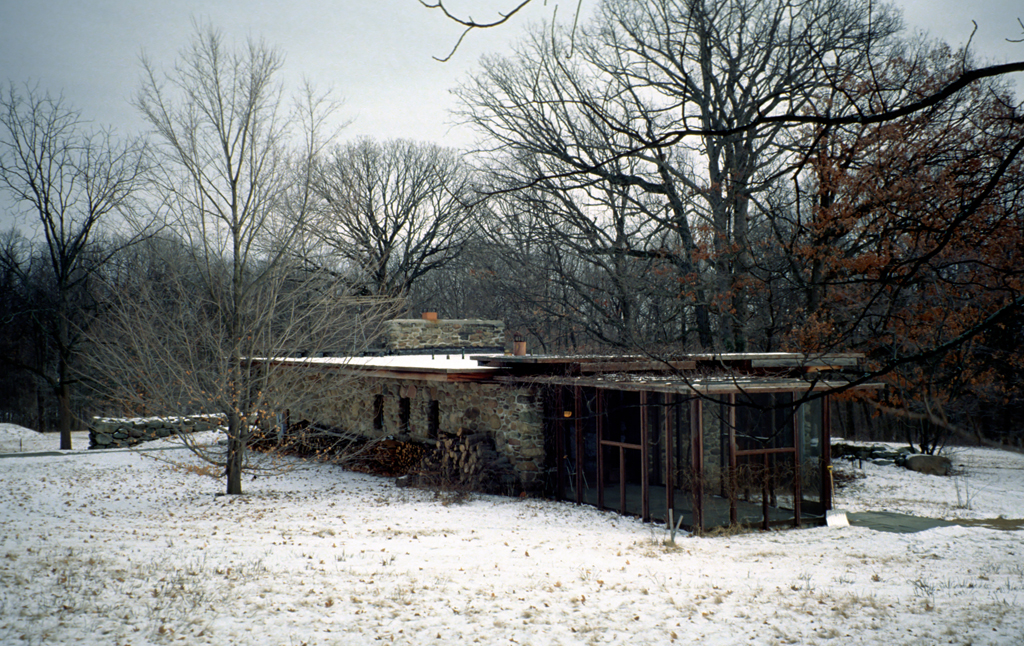
Alfred Caldwell taking in the scenery at the Domer country house in Baldwin, Kans., in 1993.

Alfred Caldwell taking in the scenery at the Domer residence in Baldwin, Kans., in 1993.


During the early post-World War II period
, Lawrence might have seemed far from the centers of innovative modern architecture — Chicago, New York, Los Angeles, Boston, and Philadelphia. In fact, Lawrence was very connected intellectually to these cities and the towering geniuses of modernism—Frank Lloyd Wright, Ludwig Mies van der Rohe, and Walter Gropius, among others—because KU’s program in architecture had turned modern in the 1920s through the influence of Professors George Beal, Joe Kellog, and later through the leadership of Professors John C. Morley and Curtis Besinger. Wright was particularly influential on the school, having befriended George Beal, who went to Taliesin West in the mid-1930s during the summer to collaborate with Wright. Wright then frequently stopped in Lawrence on his annual caravans from Taliesin in Wisconsin to his new winter quarters called Taliesin West near Phoenix. Besinger worked for Wright for 17 years, leaving the fellowship as a senior apprentice, and he not only taught Wrightian principles of modern design but also focused on Japanese architecture, which had influenced Wright’s thinking so much. His book, Working with Mr. Wright: What It Was Like, is a revealing Cambridge University Press publication that everyone interested in Wright should read. Morley, a frequent traveler to the European centers of modernism, made many connections for the school, particularly in Denmark and Scotland, where he taught on Fulbright fellowships and received additional training in modern urban design. From about 1925 to 1975, there was no one on the KU faculty who was not a “modern” architect.

As a result, dozens of young architects with modern aesthetics, technologies, and building processes graduated from KU during that key 50-year period. They flooded growing architectural firms in Topeka, Lawrence, Wichita, Kansas City, and St. Louis. They built a gigantic array of new structures that followed the tenets of architecture laid down by their professors, who promulgated modern thinking in studios and classrooms. It was impossible for these graduates to imagine building anything but modern buildings until the smoky pretensions of post-modernism began to creep into the plains during the late 1970s and early 1980s. The work of a generation of KU graduates faces the jeopardies of time and ignorance today, and our website brings that work before the public for evaluation and appreciation. These architects are “shadow figures” of modernism, architects who will never be well known but who made significant contributions to our Midwestern architectural landscape.
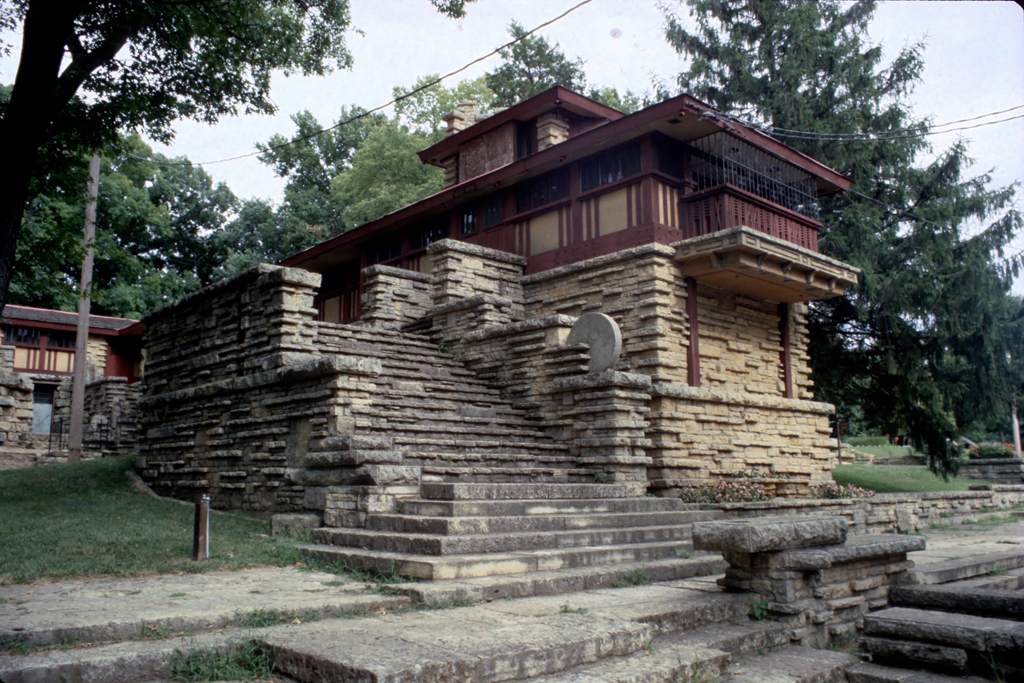
Main Pavilion, Eagle Point Park, Dubuque Iowa, 1934

Main Pavilion, Eagle Point Park, Dubuque, Iowa 1934. Architect: Alfred Caldwell

The subject of shadow figures of modern architecture is important because there were geniuses among them, some of whom came to KU to teach and lecture. One frequent visitor in the late 1980s and in the 1990s was Alfred Caldwell who was a colleague of Wright, Mies, Craig Ellwood, Hilbesheimer, and other leaders. Caldwell was a visiting professor at KU in 1980 and stayed at our home in south Douglas County on a number of occasions. I worked with him from 1980 until the late 1990s. He retired as the Ludwig Mies van der Rohe Professor of Architecture at the Illinois Institute of Technology in Chicago only two years before he died at the age of 95. He was a modern master, the last one, yet he, like our Lawrence architects, is not very well known because the stars overshadowed everyone. Slowly we are learning about them. Architecture could not have done without them!
"Farm house" designed by Alfred Caldwell, Bristol, Wisconsin 1948

“Farmhouse” designed by Alfred Caldwell, Bristol, Wisconsin, 1948

For a short account of Caldwell’s work and to see some of the fabulous landscapes and houses he designed, look at the article “The Last Master,” published in Inland Architecture magazine. It’s a synopsis of the book Alfred Caldwell: The Life and Work of a Prairie School Landscape Architect, published by Johns Hopkins University Press in 1997.

—Dennis Domer

Bruce Goff’s Bavinger House feared lost

Tom Harper of Lawrence Modern and Scott Lane of KCmodern converse with a visitor in the “living room” of the Bavinger House in Norman, Oklahoma, October 2010.

Lawrence Modern is by nature a provincial enterprise but we do patrol the architecture news front. And we have some sad news to report. We recently learned that architect Bruce Goff’s Bavinger House, located in Norman, Oklahoma, was severely damaged in June and is feared to be lost. Although it is still unclear what exactly happened — storm damage or sabotage — it is evident from local news reports that the house’s spire and roof structure had collapsed. Those knowledgeable about the house and its deteriorating condition know what this means. It is a tragedy.

Tom Harper and I had the great fortune (in hindsight) of visiting the Bavinger House in October 2010 as part of an exhibition and symposium on Goff’s works at Oklahoma University. Scott Lane and Rod Parks of the KCmodern group joined us. We were planning to do a Full Monty post about our excursion, which included visits to many other Bruce Goff houses in the area, but the current plight of the Bavinger House supersedes that. In time, we will learn the true fate of the house, which may warrant a full-blown retrospective somewhere on these pages, but for now, we can only hope that the news isn’t as bad as we’ve heard and that the house somehow can be resurrected, dim as that prospect appears. It would be a miracle.

Driveway entrance

Driveway entrance

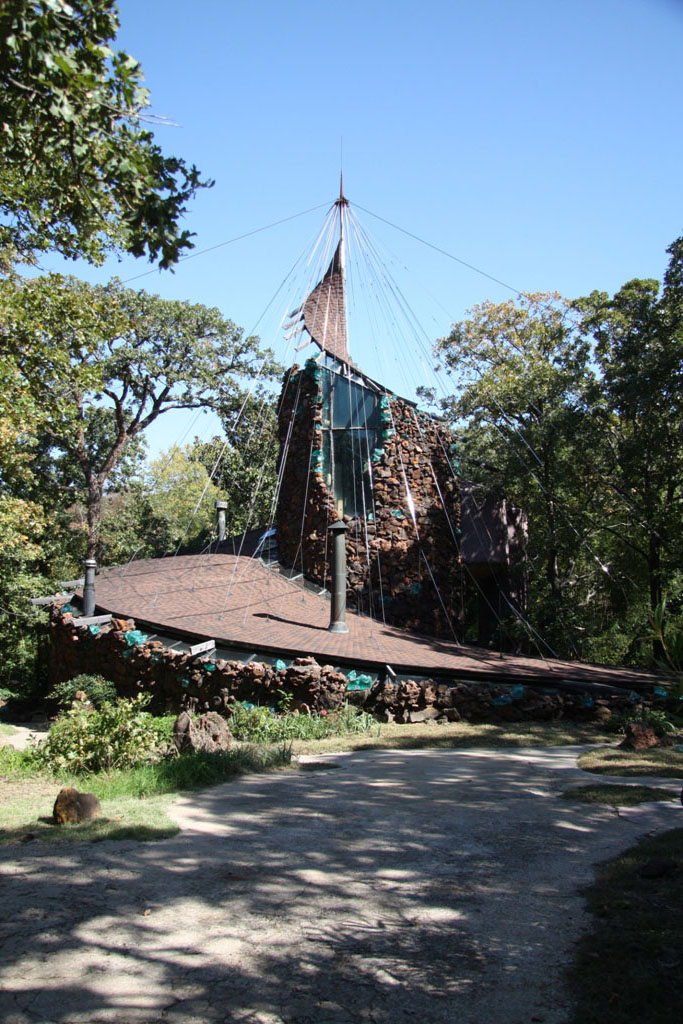
The Bavinger House is miraculous. A stone spiral heaved up out of the earth and twisting up into the sky, it is an incredibly transcendental vision of the natural world. Set in a rural, heavily wooded lot, the house was completed in 1955 and seems to exist outside of time as if thundered in by some alien force. Yet it is very much rooted in our culture. The house is a work of art built mostly out of found objects and junk — the mast is a used oil rig drilling pipe — and a reminder of the vitality of our surreal, American experience. It deserved ardent preservation, but sadly, it just didn’t work out that way.

Close-up of spire

Close-up of spire

According to reports, the house was knocked down by storm damage, but there is also speculation that the owner, Bob Bavinger, intentionally destroyed it. So far no one really knows since Bavinger, son of the original owners, hasn’t let anyone on the property to inspect.

Logarithmic spiral roof suspended by airplane cables

Logarithmic spiral roof suspended by airplane cables

Before it was toppled, the roof of the house was supported by cables projecting from the central steel mast, as seen in the photos above. (The original roof was made of wood shingles.) The rods, made of WWI-era airplane wire, also supported the interior floating pods, which functioned as the “rooms” of the house. The exterior wall of the house — and there is only one wall — is made of locally quarried ironstone. Discarded aqua-green glass cullets are embedded into the stone, and when the sun shines on them they glow like kyrptonite. Goff liked to use recycled objects because he believed that architecture should be organically tied to a particular place, but he also recycled to keep costs down. (The Bavinger House reportedly cost only $2,150 to build.) In this sense, the Bavinger House is one of the most elaborate yet cost-effective examples of folk art ever made.

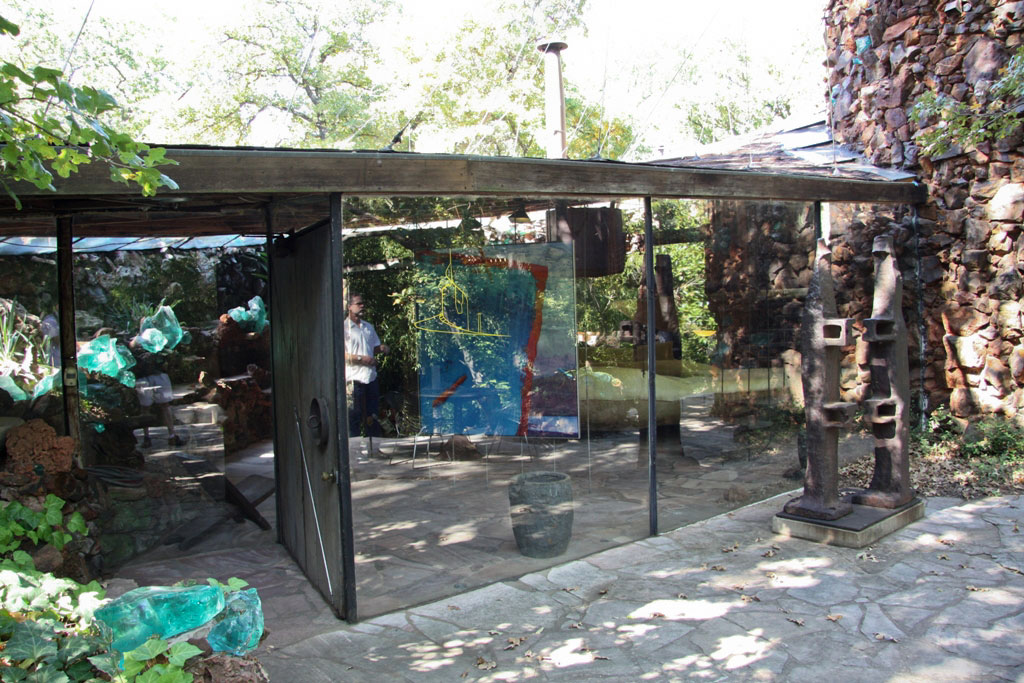
House entrance

House entrance

Photography cannot possibly convey the essence of things, but as is often the case, it’s all that remains when things are gone. As Susan Sontag once said, eventually all photographs become precious relics of an irretrievable past.

Like Frank Lloyd Wright’s Fallingwater, so much has been written about the Bavinger House, Goff’s masterpiece, that it feels redundant to add much more. Suffice it to say that visiting the house had a profound effect on both of us. It pushed me to stop and think not only about architecture but also about the world around me. This is what great art does.

Any youth of today who wishes to expand his or her sense of what is possible in art and architecture should study Bruce Goff and, given the opportunity, visit his incredibly diverse creations. The Bavinger House may no longer be on the itinerary, but there are many other worthy houses to see. Seek them out and be prepared to enter a universe solely of the architect’s imagination, one unlike any other in the history of American architecture.

—Bill

Postscript: The November 15, 2012 issue of This Land reports that in an act of apparent self-destruction on the part of the owner, the Bavinger House was dismantled and its pieces are for sale.

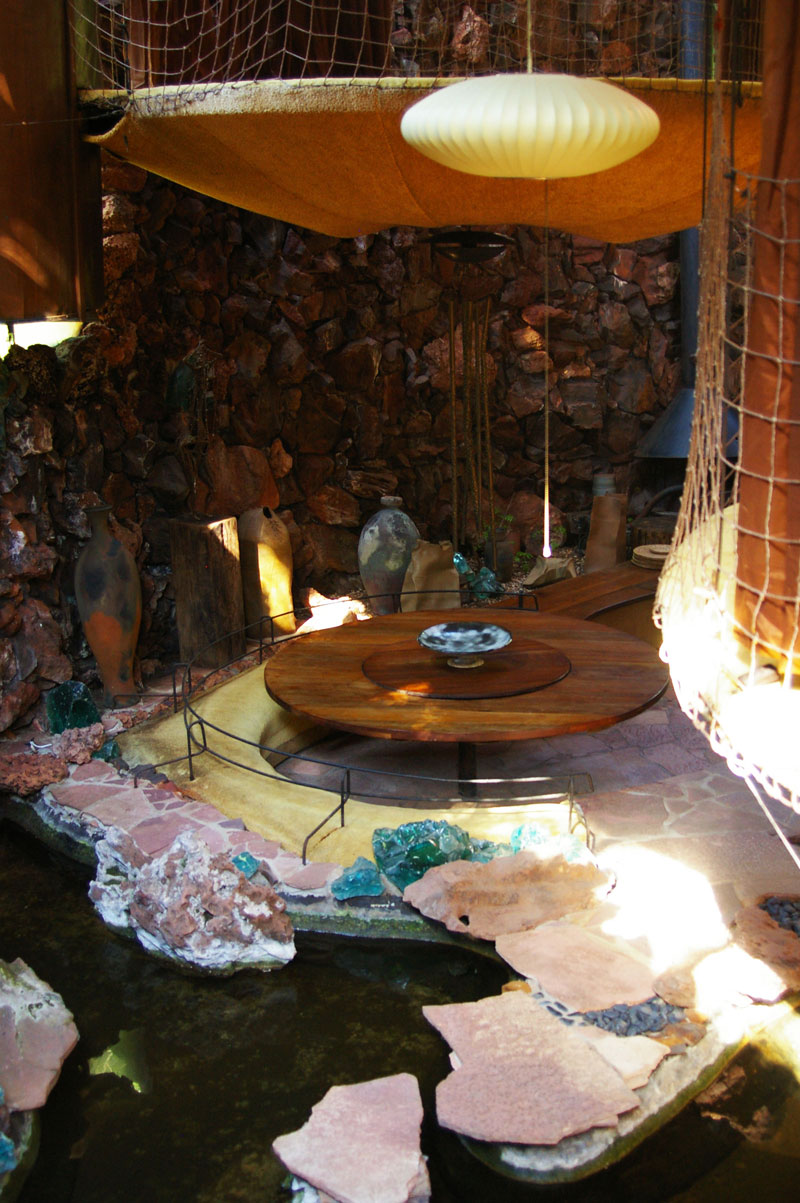
Dining room with koi pond in foreground

Dining room with koi pond in the foreground

Kitchen

Kitchen

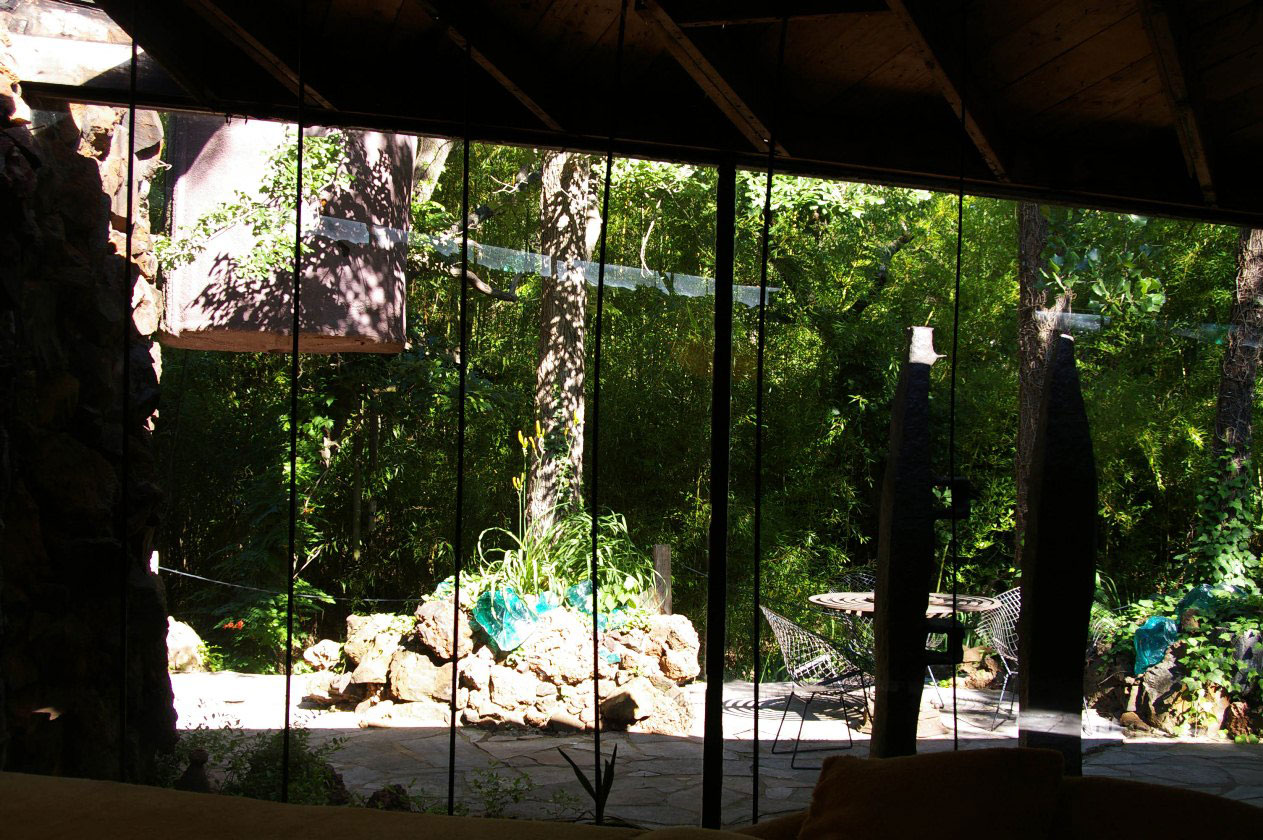
Looking out onto front patio from living room pod

Looking out onto the front patio from the living room pod

[Click here to see more photos.]

How my chair addiction opened doors

Herman Miller Eames Aluminum Group chair

Herman Miller Eames Aluminum Group chair

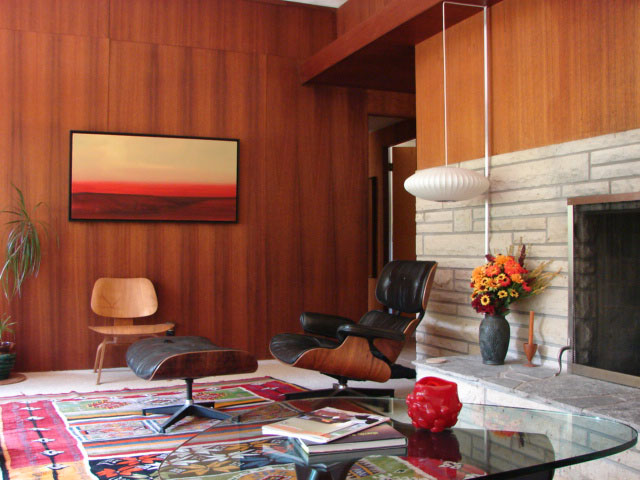
I confess. I have an addiction to modern chairs. I have accumulated so many that my wife, Terri, often shakes her head in exasperation whenever I bring home my latest acquisition or junk find. “Why did you buy that?” and “Where are you going to put it?” have become the reflex responses. It all started one day in 1998 at an antique store in Helena, Arkansas, while I was visiting a friend in Louisiana. Two seasoned young men were taking a break from refinishing turn-of-the-century furniture, and one of them was sitting in the chair pictured above. I had no idea what the chair was, who made it, or even where I was going to put it, but the unusual shape caught my eye. I asked them if I could give it a spin. One said okay. The chair was surprisingly comfortable. I knew it wasn’t for sale, but I offered $50 cash on a whim anyway. Both quickly declined, saying, “Oh no, it isn’t for sale — this is our sitting chair!” I pressed again to no avail and left, but one of the men followed me out to my truck and said, “We’ll take it.” I loaded it and began my journey back to Lawrence. Little did I know the chair would lead to an obsession with midcentury architecture and, ultimately, to our current home on Owens Lane. When I got back to Lawrence, I showed the chair to a neighbor who confirmed it was an Eames Aluminum Group chair made by a furniture company called Herman Miller. I later learned this model was first released in 1958 and is still sold by the company. It became my office chair at work.

Eames 670/671 Lounge Chair and Ottoman in its natural habitat

Eames 670/671 Lounge Chair and Ottoman in its natural habitat

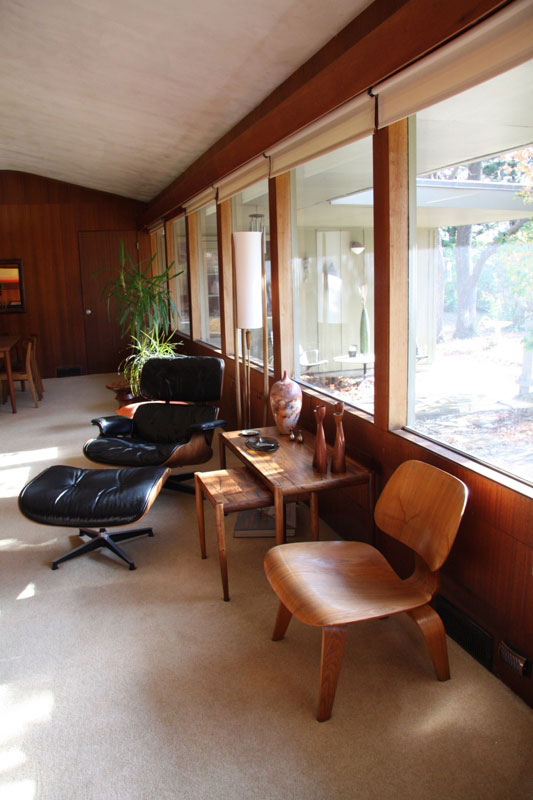
Shortly after the Aluminum Group chair purchase, Terri and I were looking through a magazine and saw an Eames 670/671 Lounge Chair and Ottoman. She said, “Oh, I really like that.” I gasped at the price, however, and said I would never spend that much money on a chair. (A new one from Herman Miller costs more than $5,000.) A couple weeks later, I was driving down an alley in Old West Lawrence and spotted an original (Rosewood) Eames 670/671 lounge chair and ottoman near a pair of trash cans. I couldn’t believe it. The leather was ruined, but the shells were in excellent condition. I had them recovered by an upholstery shop in Kansas City for under $1,000. The chair is still in our living room. It’s supremely comfortable, and the smell of the leather and exotic rosewood shells makes sitting in it all the more pleasurable.

Eames 670/671 Lounge Chair and Ottoman & plywood lounge chair

Eames 670/671 Lounge Chair and Ottoman & plywood lounge chair

After these two very fortunate furniture finds, I began to scour every garage sale, yard sale, and estate sale in Lawrence on the hunt for more modern furniture. Our home is now filled with vintage furniture and objects — Hans Wegner chairs and tables, George Nelson bubble lamps, an Isamu Noguchi coffee table, pieces by Charles and Ray Eames, and other mod stuff. To make a long story short, my chair fetish sparked an interest in modern design and eventually led to the home we currently live in. It also led to Lawrence Modern. They (the chairs) opened up many doors (literally) for me to meet many wonderful people, photograph beautiful houses, and learn more about our rich history of modernism here in Lawrence.

—Tom

An (architecturally) cool summer afternoon

We enjoyed a well-fed and cool (architecturally speaking) summer afternoon Sunday, June 12, 2011 at the home of Doug & Alice Hewitt, owners of this 1956 gem at 918 Highland Dr., next to the Hillcrest Elementary. The house was designed by Robert Hess, a KU architecture grad, for Reuter Organ executive Franklin Mitchell and his family. If you missed the gathering you can watch the video and hear architectural historian Dennis Domer talk about the house’s wonderful design. You can also check out the house on our Baker’s Dozen list here.

A passion for buildings

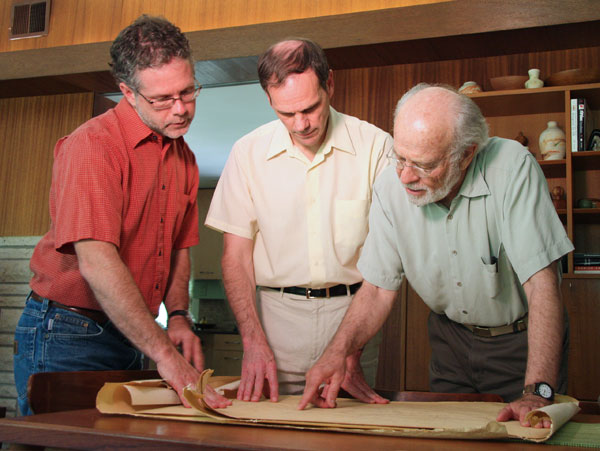
Tom Harper, Bill Steele, and Dennis Domer

A passion for buildings often brings people together who otherwise might never have met and become friends. The desire in 2009 to find and document the best modern houses in Lawrence brought me luckily into contact with two young men who wanted to do the same thing: Tom Harper, a Realtor and founder of Lawrence Modern, and Bill Steele, an administrator at KU and a modern architecture aficionado. Through his work, Tom had located about 20 residences built between 1935 and 1965 that he thought were especially worthy of consideration, and during our work together, we found about a dozen more. Over the last two years we have visited more than 30 modern houses, photographed them, gathered historic photographs, scanned drawings, interviewed architects, gone to archives, talked with owners, and puzzled and marveled over what we found. All this work forged a good natured comradeship among us that is only at the beginning.

After two years on and off, we are also only at the beginning of our study of modern houses, but we have enough results now to share our initial findings in a collection of fine houses we call our “Baker’s Dozen.” The Baker’s Dozen indicates something about our attitude toward our subject. We are willing to go out on the limb to pick a number of the best houses we found, but we also want to state that a dozen does not do justice to modern houses in Lawrence. There are many more in Lawrence we need to see and experience before we have a fuller understanding of mid-century modern residential buildings and why a university town like Lawrence once proudly boasted progressive architecture.

Recognizing that we had different backgrounds and experiences of modern architecture, we decided to reduce somewhat the subjective natures of our individual evaluations by developing ten criteria to consider on a scale of one to ten, one being the lowest score and ten being the highest score possible. If you take a look at one of the Baker’s Dozen, you’ll find a “view details” button which will show you how the house fared on factors we call integrity of original design, spatial relationship of elements, quality of site, quality of materials, condition, floor plan livability, quality of natural light, memorability, artistic value, and how does the house feel. Our first evaluations sometimes found us significantly far apart in these factors, but we learned from each other to quickly create a common standard that sometimes brought our evaluations into uncanny agreement. We always filled out our forms independently without discussion and right after we had completed our visits for the day. Our evaluations do not suggest some kind of truth to be accepted as gospel but rather represent the opinions of three people who love what they are doing and are willing to learn more.

This work has been especially a pleasure for me because over a career in architecture and teaching of more than 35 years I came to know most of the architects whose work we so admire. George Beal, John C. Morley, Tom Geraughty, and James Williams were outstanding faculty at the University of Kansas and practicing professionals who influenced a generation of modern architects and themselves made very important contributions to modern architecture in Lawrence and the region. Robert Hess, Warren Heylman, and Richard Peters, all graduates of KU and now well into their 80s, led architecture firms that became known for modern architecture in Los Angeles, Spokane, and Lawrence from the 1950s into the 21st century. Through their work alone, I have come to know Dana Dowd, also a KU graduate who did a number of buildings in Lawrence in the 1950s and 1960s, Mackie & Roarke, and Tsuroka Martin Melvin & Osborne. All of these architects were passionately dedicated to the cause of modern architecture.

We hope that you have an enlightening time looking at our work and ask for your comments and help as we continue our study. In any case, we hope you sense our enthusiasm for the modern expression in our Kansas university town.

—Dennis Domer